null
Early Black Friday SALE: Up to 55% Off on Home Saunas Shop Now

Our Locations

Ontario Location
2051 S. Lynx Avenue, Ontario, California 91760 USA
(909) 321-2858
  • Mon – Fri: 9 am – 4 pm PST
  • Sat: Closed
  • Sun: Closed
  • Major Holiday: Closed
Book an appointment
Get Directions
Irvine Location
101 Progress #150, Irvine, California 92618 USA
(949) 408-3887
  • Mon – Fri: 9 am – 5 pm PST
  • Sat: Closed
  • Sun: Closed
  • Major Holiday: Closed
Get Directions

Search JNH

Type at least 3 characters for suggestions, or press Search.

Home/Our Engineering/VOC & Formaldehyde Testing

What’s in the air
inside your infrared sauna?

A closer look at the materials we build with.
And the air inside an operating sauna.

We commissioned two independent assessments with SGS and VERT Environmental, so you can look beyond material descriptions and review the measured findings.

Explore the test resultsSee testing details
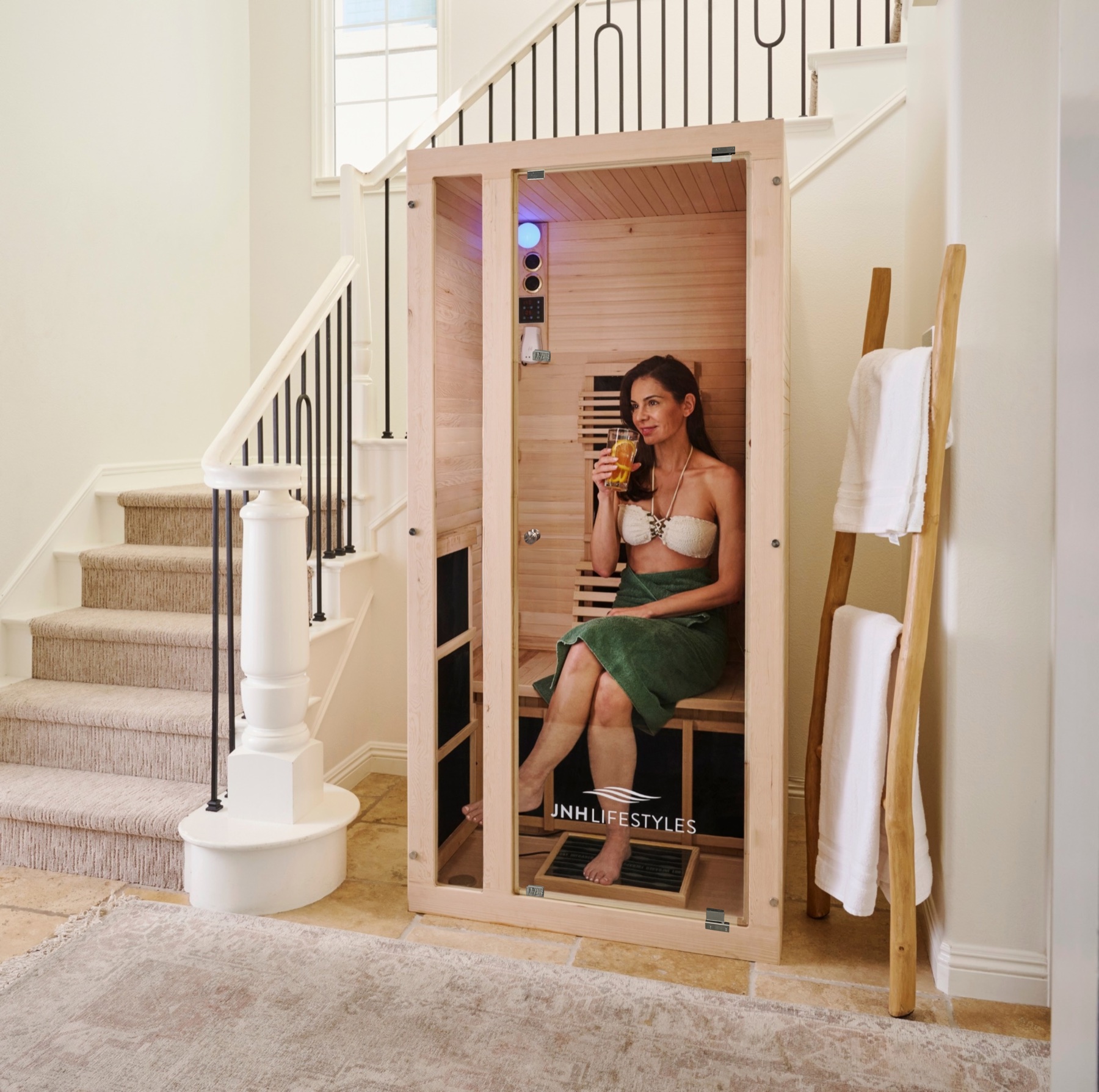
A person relaxing inside a JNH wood infrared sauna at home

Independent testing results

One examines a sauna wall panel. The other samples the air inside an operating sauna. Here is what each found.

SGS 🇨🇭Materials assessment

Sauna Wall Panel

TVOC

Not detected

Formaldehyde

Not detected

At the 96-hour chamber measurement of the submitted sauna wall-board specimen.

Controlled conditionsApproximately 23°C / 73°F

California Specification 01350,
Version 1.2

Understand the SGS results
VERT 🇺🇸Cabin air assessment

Sauna Cabin and Surrounding Air

3 µg/m³Reported difference

A comparison of samples, not an emissions rate.

93 µg/m³Inside the sauna
90 µg/m³Nearby reception

Detected target VOC concentrations in two air samples collected during the assessment.

VERT guideline: Low - under 300 µg/m³

Both samples fall within VERT’s Low classification. This is an assessment guideline, not a regulatory safety threshold.

Understand the VERT results

Why we tested our saunas

When choosing an infrared sauna, it's natural to compare temperature, heater technology, wood type, and features. Those specifications tell you how a sauna performs, but they don't tell you everything about the environment inside the cabin.

Heat can influence how certain materials release volatile organic compounds (VOCs), making the wood, adhesives, interior surfaces, and construction methods important considerations when selecting a sauna for your home.

At JNH Lifestyles, we believe questions about sauna air quality deserve more than reassuring marketing claims. We commissioned two independent assessments: one to evaluate emissions from our actual sauna wall-panel construction, and another to measure VOC concentrations inside an operating infrared sauna.

Together, these assessments provide measured information about our construction materials and the air inside an assembled sauna, giving our customers evidence they can examine rather than relying on general claims about low emissions.

Wall-panel emissions testing

A representative sauna wall panel brings the wood, adhesive and assembly together. Testing that component goes beyond testing an ingredient on its own.

What this test covers

The submitted wall-board specimen under controlled chamber conditions. It is not a whole-sauna test at operating temperature.

Report CANPC26023051501
96-HOUR CHAMBER MEASUREMENT

TVOC: Not detected.
Formaldehyde: Not detected.

Formaldehyde was below the 2 µg/m³ reporting limit. The chamber was approximately 23°C, rather than sauna operating temperature.

What we tested

A sauna wall panel is more than a piece of wood. Depending on its construction, it may incorporate solid wood, adhesives, fasteners, and other materials introduced during manufacturing. All of these become part of the finished component.

When evaluating potential VOC emissions, there's an important distinction between testing an individual adhesive and testing the assembled wall panel that will actually be used in the sauna.

At JNH, we chose to test the assembled wall-panel construction.

Who is SGS?

SGS is a globally recognized testing, inspection, and certification company headquartered in Switzerland. Founded in 1878, it has more than a century of experience evaluating materials and products across a wide range of industries.

With an international network of laboratories and technical specialists, SGS provides independent testing and evaluation services using established methods and standards.

For our assessment, we engaged SGS-CSTC Standards Technical Services to evaluate chemical emissions from a representative sauna wall-board specimen. The test followed California Specification 01350, Version 1.2, an established environmental chamber method for evaluating VOC emissions from indoor materials.

We chose SGS because we wanted our production materials evaluated by an independent organization with extensive technical expertise and a longstanding international reputation for testing.

Testing our production materials

The wall-board sample submitted to SGS was manufactured using the same wood, adhesive, and construction methods used in our regular sauna production. Rather than submitting an unrelated piece of raw lumber or a specially selected adhesive sample, we provided a representative panel made from the materials used in our saunas.

This is important because testing an adhesive alone provides information about that specific adhesive, while testing the assembled wall panel evaluates emissions from the complete construction. Under controlled laboratory conditions, SGS measured compounds released into the chamber air, including any contributions from the wood, adhesive, and other materials incorporated into the sample.

We chose this approach because we wanted the testing to reflect the wall-panel construction our customers actually receive.

Why SGS tested a panel rather than a whole sauna

We explored testing a complete assembled sauna with SGS. However, the laboratory uses specialized environmental chambers designed to maintain carefully controlled temperature, humidity, and airflow conditions, and the available chamber could not accommodate a full sauna.

Rather than stop there, we took two complementary approaches:

  • We submitted representative sauna wall-panel construction for controlled chamber emissions testing by SGS.
  • We separately commissioned VERT Environmental to measure the air inside an assembled sauna.

This allowed us to investigate both the construction materials and the actual cabin-air environment. The two assessments use different methods and answer different questions, providing additional information that either test alone would not establish.

SGS findings and reporting limits

SGS completed our material emissions assessment in September 2026. The wall-board sample was conditioned before undergoing controlled environmental chamber testing, with air measurements taken at defined intervals.

At the 96-hour chamber measurement, SGS reported:

SubstanceSGS Result
Total Volatile Organic Compounds (TVOC)Not Detected
FormaldehydeNot Detected
AcetaldehydeNot Detected
BenzeneNot Detected
TolueneNot Detected
StyreneNot Detected
XylenesNot Detected

No non-listed VOCs were reported as detected at the 96-hour measurement.

What does “not detected” actually mean? A not detected result means the measured concentration was below the laboratory's applicable detection or reporting limit. It does not mean that a substance is necessarily present at an absolute concentration of zero.

For example, formaldehyde was not detected in the 96-hour chamber air sample above the report's 2 µg/m³ reporting limit. SGS also calculated a modeled formaldehyde concentration of 0.3 µg/m³ for its specified private-office scenario, below the applicable 9 µg/m³ criterion.

These are meaningful findings about the tested component under the stated laboratory conditions, not a claim that every material in every sauna produces zero emissions.

SGS Assessment Details

DetailInformation
LaboratorySGS-CSTC Standards Technical Services, Guangzhou Branch
Report numberCANPC26023051501
Report dateSeptember 10, 2026
SampleSolid Wood Board of Sauna Room
MethodCalifornia Specification 01350, Version 1.2
Chamber temperatureApproximately 23°C

By testing our assembled sauna wall panel, we obtained independent measurements that go beyond descriptions of our wood and adhesive.

But testing the materials in a controlled chamber raises another important question: What about the air inside an assembled sauna when it's operating?

That's what we investigated with VERT Environmental.

Air sampling inside the sauna

Air samples from inside an operating sauna and a nearby reception area help put the findings in their surrounding indoor context.

What this test covers

Two samples at JNH’s Irvine facility. The difference does not isolate the sauna’s own emissions or establish zero emissions.

Project 68541.1 · October 2026
SAUNA AIR93 µg/m³
RECEPTION AIR90 µg/m³

Laboratory-reported totals of detected target VOCs. The visual compares sample concentrations, not a safety limit.

Why we sampled the reception area too

In October 2026, we commissioned VERT Environmental Testing & Consulting Services to evaluate VOC concentrations inside a JNH infrared sauna at our Irvine, California office.

Instead of measuring only the air inside the sauna, we also collected a comparison sample from the nearby reception area.

This comparison was important because VOCs aren't unique to saunas. They can also be present in the surrounding environment from furniture, cleaning products, building materials, personal care products, and other everyday sources.

Without knowing what compounds were already present in the surrounding indoor air, it would be harder to determine how the sauna measurement compared with its environment.

Results from the two air samples

On October 15, 2026, VERT collected two air samples, which were subsequently analyzed by LA Testing.

The laboratory reported:

Sampling LocationTotal Detected Target VOCs
Inside the JNH infrared sauna93 µg/m³
Nearby reception area90 µg/m³
Difference3 µg/m³

The concentrations differed by just 3 micrograms per cubic meter, with both measurements falling within VERT's Low classification of less than 300 µg/m³ under its general air quality guidelines.

The laboratory also detected the same four target compounds at similar concentrations in both locations.

VERT's 300 µg/m³ guideline is an interpretive reference, not a regulatory safety threshold for total VOCs.

Compounds detected in each sample
CompoundInside SaunaReception Area
Chloromethane1.2 µg/m³1.2 µg/m³
Ethanol55 µg/m³54 µg/m³
Isopropyl alcohol7.8 µg/m³7.5 µg/m³
Acetone29 µg/m³27 µg/m³
Total Detected Target VOCs93 µg/m³90 µg/m³

Totals reflect the laboratory's reported values and rounding conventions.

What the difference tells us

The important finding isn't simply that the two numbers are close. It's that the air inside our operating sauna and the nearby reception area contained the same four detected VOCs at very similar concentrations.

This gives us useful context for understanding what was measured inside the sauna. For example, ethanol and isopropyl alcohol are common in indoor products because they're found in cleaning products, disinfectants, and other household materials. Detecting these compounds inside a sauna doesn't necessarily mean they came from the sauna's construction.

The reception-area sample showed that these same compounds were already present in the surrounding environment at comparable concentrations.

However, the 3 µg/m³ difference does not independently establish the sauna's own VOC emission rate. It also does not prove that the sauna contributed no emissions.

The measurements describe the sampled air under the conditions of the assessment.

For a customer evaluating sauna air quality, that's an important distinction: a VOC reading inside a sauna is not, by itself, a measurement of what the sauna is releasing.

Heating and cooling during sampling

The sauna underwent an approximately two-hour heating and cooling cycle.

For the first 60 minutes, we operated the sauna with the heaters set to 170°F. We then switched the heaters off and allowed the sauna to cool naturally for approximately another 60 minutes. The sauna doors remained closed throughout the testing period.

The reported air results represent the applicable sampling intervals. They should not be interpreted as continuous measurements at a verified, constant 170°F cabin temperature.

How the samples were analyzed

VERT collected the air samples using specialized stainless-steel canisters, with laboratory analysis performed by LA Testing.

The samples were analyzed using EPA Method TO-15, which identifies and measures specified volatile organic compounds in air through gas chromatography/mass spectrometry (GC/MS).

This method provides results for individual compounds and their concentrations, rather than relying on odor or a general air quality indicator.

VERT also compared the detected compounds with published occupational and environmental screening levels, including references from OSHA, NIOSH, the U.S. Environmental Protection Agency, and California environmental health authorities. All detected compounds were reported below the applicable screening levels considered in the assessment.

VERT Assessment Details

DetailInformation
Environmental consultantVERT Environmental Testing & Consulting Services
Analytical laboratoryLA Testing
Sampling dateOctober 15, 2026
Report dateOctober 23, 2026
Project number68541.1
Analytical methodEPA TO-15

The assessment documents the air measured inside our operating sauna and in the nearby reception area at the time of testing at our Irvine office. It is not a certification of every JNH sauna model or a guarantee of identical results under all operating conditions.

Why sauna materials matter

Independent testing helps us understand what compounds are released into the air, but the materials and construction methods used to build a sauna are equally important considerations.

An infrared sauna is an enclosed space designed for repeated heating and cooling. The wood, joinery, adhesives, and interior surfaces all become part of that environment, which is why we pay close attention to how our saunas are constructed.

Solid Canadian Hemlock and Canadian Red Cedar

Depending on the model, our infrared saunas are built using solid Canadian Hemlock or Canadian Red Cedar. The cabins feature natural wood interior surfaces without added decorative paints or finishes.

Tongue-and-Groove Construction

Our sauna panels use tongue-and-groove construction with more than 40 narrow wooden battens per panel. This interlocking design allows individual boards to accommodate the natural expansion and contraction of wood as temperatures change, while helping distribute structural support throughout the panel.

Because the boards fit together through this interlocking construction, we can also reduce our reliance on adhesive bonding for the cabin's primary structure.

Rice-Based Adhesives and Emissions Testing

Where adhesives are necessary, we use rice-based adhesives as part of our construction specifications.

But rather than asking customers to assume that a particular adhesive is automatically safer, we believe it's more useful to examine emissions from the actual assembled construction. A finished sauna panel contains wood, adhesives, and other incorporated materials, all of which can contribute to the compounds released into the air.

This is why we chose to have SGS evaluate our assembled wall-panel construction using the actual wood and adhesive from our production process. We wanted independent measurements of how these materials perform together in the finished component.

Understanding VOCs in an infrared sauna

Volatile organic compounds (VOCs) are chemicals that can enter the air from a variety of natural and manufactured sources. They're commonly associated with paints, adhesives, furniture, cleaning products, building materials, and other everyday items. Some occur naturally in the environment, while others are released from household or industrial products.

Importantly, not all VOCs are the same. Understanding their potential health effects requires looking at the specific compound, its measured concentration, exposure duration, and the conditions under which testing was performed.

For infrared sauna buyers, heat introduces another consideration. Elevated temperatures can increase emissions from certain materials, making it especially important to understand how a sauna's construction has been evaluated.

This is why broad claims such as "chemical-free" or "zero VOC" deserve scrutiny. Those descriptions alone don't explain what was tested, how the testing was conducted, or what the results actually establish.

A credible assessment should help answer several questions:

  • What was actually tested?
  • Was the sample a raw ingredient, an assembled component, or the air inside a sauna?
  • Was the test performed under controlled laboratory conditions or during sauna operation?
  • Which compounds were measured?
  • Were the results compared with appropriate background measurements?
  • What do the findings establish, and what remains outside the scope of testing?

These are the questions we believe customers should ask when evaluating VOC claims, regardless of which sauna manufacturer they're considering.

Independent Testing & Verification

Identifiable laboratories, methods and reports. Review our independent testing methods, findings, and documented results below.

Material emissions

SGS 🇨🇭 material emissions report

California Specification 01350,
Version 1.2

DetailInformation
LaboratorySGS-CSTC Standards Technical Services, Guangzhou Branch
Report numberCANPC26023051501
Report dateSeptember 10, 2026
SpecimenSolid Wood Board of Sauna Room
MethodCDPH Standard Method V1.2 / California Specification 01350
Chamber temperatureApproximately 23°C
Reported results96-hour measurement, including VOCs and formaldehyde
Cabin air

VERT 🇺🇸 air sampling report

DetailInformation
Environmental consultantVERT Environmental Testing & Consulting Services
Analytical laboratoryLA Testing, Huntington Beach, CA
Project number68541.1
Sample collection dateOctober 15, 2026
Report dateOctober 23, 2026
Sample locationsInside sauna and nearby reception area
Analytical methodEPA TO-15
Reported resultsTarget VOC concentrations in both air samples

The results reflect the specimens, locations, methods, and conditions evaluated in each assessment. They should not be treated as comprehensive emissions certification for every sauna model or every possible use condition.

Questions About Our VOC Testing?

Our independent VOC testing findings are summarized above, including the testing organizations, methods, conditions, and key results.

If you have questions about the testing process or what the findings mean for your sauna, our team is happy to help.

Ask Us About Our Testing

Common questions about VOCs

Understand what the testing can tell you before choosing your sauna.

Ask a JNH specialist
Are JNH infrared saunas VOC-free?

We don't claim that our saunas are completely VOC-free. Independent SGS testing reported no detectable total volatile organic compounds (TVOC) in a representative sauna wall-board specimen at the 96-hour chamber measurement.

Our separate VERT assessment measured 93 µg/m³ of detected target VOCs inside an operating sauna, compared with 90 µg/m³ in the nearby reception area. The two assessments evaluated different aspects of sauna construction and air quality under different conditions.

Have you independently tested for formaldehyde?

Yes. We commissioned SGS to evaluate a representative sauna wall-board specimen for formaldehyde using California Specification 01350, Version 1.2.

At the 96-hour chamber measurement, formaldehyde was not detected above the laboratory's reporting limit of 2 µg/m³. This result applies to our tested wall-panel construction under controlled laboratory conditions, rather than a direct formaldehyde measurement inside a heated, assembled sauna.

Do you test only your sauna adhesive?

No. We submitted a representative wall-panel sample manufactured using the same wood, adhesive, and construction methods used in our regular sauna production.

SGS evaluated emissions from the assembled construction, allowing us to assess the finished wall panel rather than relying solely on an adhesive test.

Why is testing an assembled wall panel different from testing glue?

Testing an adhesive alone measures emissions from that particular adhesive sample. Testing an assembled wall panel evaluates emissions from the complete construction, including contributions from the wood, adhesive, and other incorporated materials.

Both methods provide useful information, but they answer different questions. We chose to test our assembled wall panel because it more closely represents the construction our customers actually receive.

Why didn't SGS test a complete sauna?

We explored testing an entire assembled sauna, but the available SGS environmental chamber could not accommodate a full cabin.

Instead, we commissioned SGS to evaluate our representative sauna wall-panel construction under controlled laboratory conditions and separately worked with VERT Environmental to measure VOC concentrations inside an operating infrared sauna.

These two assessments allowed us to examine both the materials used in our construction and the air inside the assembled sauna. However, neither test establishes emissions performance at every possible operating temperature or throughout a sauna's lifetime.

Was your sauna tested at 170°F?

We operated the sauna with the heaters set to 170°F for the first 60 minutes of the VERT assessment. We then switched the heaters off and allowed the sauna to cool naturally for approximately another 60 minutes, keeping the doors closed throughout the process.

The assessment included a heating and cooling cycle, with the laboratory measuring the air collected during the applicable sampling intervals. The 170°F figure refers to the heater setting rather than a continuously verified cabin temperature throughout testing.

Our separate SGS material emissions assessment was conducted under controlled laboratory conditions at approximately 23°C (73°F).

What does 93 µg/m³ mean?

Micrograms per cubic meter (µg/m³) is a unit used to express the concentration of a substance in air.

In our VERT assessment, 93 µg/m³ was the total concentration of detected target VOCs in the sauna air sample. The nearby reception-area sample measured 90 µg/m³, with the same four compounds identified at similar concentrations.

Both measurements fell within VERT's Low classification under its general air quality assessment guidelines.

A combined VOC concentration alone does not determine health risk. The specific compounds, their concentrations, and the conditions of exposure also matter.

Does “not detected” mean absolutely zero?

No. A not detected result means that a compound was below the laboratory's applicable detection or reporting limit under the specified testing conditions. It does not mean the substance was completely absent at every possible concentration.

For example, SGS reported that formaldehyde was not detected above the 2 µg/m³ reporting limit at the 96-hour chamber measurement.

Is JNH SGS-certified for low VOC emissions?

No. We commissioned independent laboratory emissions testing from SGS, not a certification of our complete sauna lineup.

SGS evaluated a representative sauna wall-board specimen and issued a report documenting the results, including the 96-hour findings for TVOC and formaldehyde.

The assessment provides independent measurements of our tested wall-panel construction under a recognized testing method. It should not be interpreted as certification of every component or complete sauna model.

Can I review the independent testing reports?

Yes. You can contact our Customer Service team to request the SGS material emissions report and VERT sauna air quality assessment.

Both reports provide additional details about the testing methods, results, and conditions evaluated. We're happy to help explain the findings so you can make an informed purchasing decision.

Transparency You Can Measure

When choosing an infrared sauna, you deserve to understand more than how hot it gets or how many heaters it contains.

You should be able to ask meaningful questions about its materials, how it's built, and what independent measurements say about its air quality.

Read more about our independent testing

At JNH Lifestyles, those questions are part of how we approach product development and customer education.

We commissioned SGS to evaluate emissions from representative wall-panel construction made with our actual production materials.

We commissioned VERT Environmental to measure VOC concentrations inside an assembled sauna and in the surrounding indoor environment.

These tests don't answer every possible question about sauna emissions. But they provide independently measured evidence that customers can examine rather than simply taking our word for it.

Because when it comes to the air inside your sauna, transparency matters.

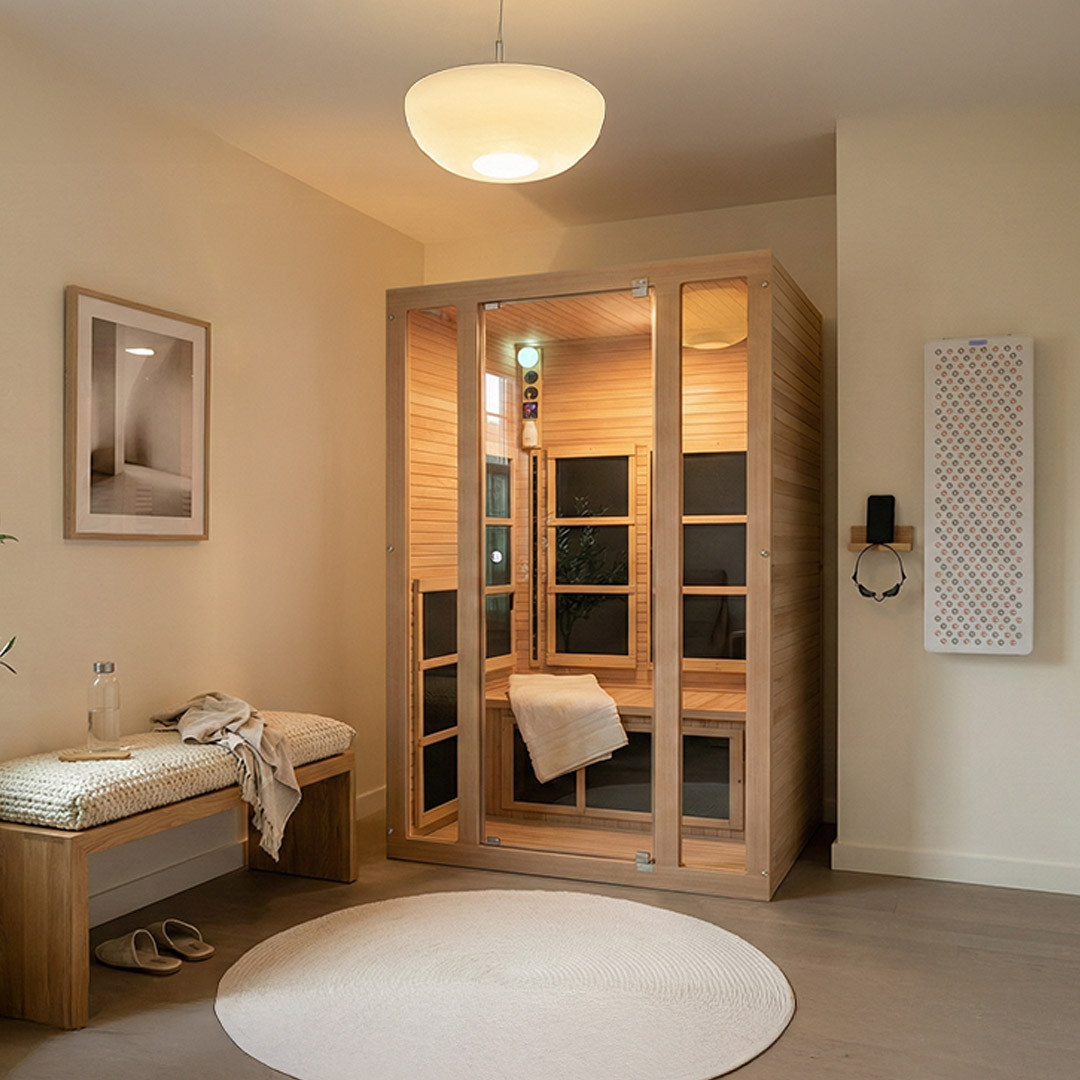
JNH Tosi two-person cedar sauna in a home setting

Your Cart (0 items)

  • Your cart is empty.